Wednesday, December 18, 2019

Old News is Good News

It's been over 6 years since I wrote about the grotesquerie in the Montana court room of the Honorable G Todd Baugh when he gave a slap on the wrist to Stacey Dean Rambold after Rambold raped a 14 year old girl who was a student in his high school class. The girl, who later committed suicide while the trial was pending. 


The Dishonorable G Todd Baugh

The now Dishonorable G Todd Baugh was censured and suspended as a judge by the Montana Supreme Court in 2013 for that judgment,particularly his opinion that the 14 year old victim "appeared older than her chronological age."
In a six-page ruling, the court said Baugh’s actions warranted suspension without pay for 31 days. Noting Baugh's term expires at the end of the year and that he did not seek re-election, the court said the suspension would begin on Dec. 1.

The verdict against Rambold was also overturned by the Montana Supreme Court, who sentenced Rambold to 15 years, with 5 suspended, for the rape of the girl.


The rapist, Stacey Dean Rambold
Both stories are good news, though thin justice for the young girl who was raped by her high school teacher and subsequently killed herself.

Of concern though, is the further development, from 2017, that Rambold has apparently been paroled by the State of Montana after serving only 2 1/2 years in prison,  having completed a sex offender program, and paroled to the Great State of California.

Cherice Moralez (1993-2010)

In your charity, please lift an Ave for the repose of the soul of Cherice Moralez.

In paradisum deducant te Angeli; in tuo adventu suscipiant te martyres, et perducant te in civitatem sanctam Jerusalem. Chorus angelorum te suscipiat, et cum Lazaro quondam paupere æternam habeas requiem.
"May the angels lead you into paradise; may the martyrs receive you at your arrival and lead you to the holy city Jerusalem. May choirs of angels receive you and with Lazarus, once a beggar, may you have eternal rest."

Pope Francis and the title of Our Lady as "Co-redemptrix" - Part 2 .... a reply to Fr. George David Byers

In my previous article, "Pope Francis and the title of Our Lady as "Co-redemptrix", I had requested that another blogger, Fr. Byers of Let Us Arise!, remove his erroneous attacks against Pope Francis. I had posted a quoted and corrected version of the message I had sent to him.

Fr. Byer did not approve that post as a reply to his blog. Instead he obliquely referred to my comments, playing off the fact that I am an architect, with another essay titled Co-Redemptrix unnecessary for faith? Un-architecting “relational signifiers”.

Suffice it to say, that Fr. Byer did not address anything of substance in terms of his errors of what the Holy Father actually said, nor even to the point of how a formal definition of "Co-Redemptrix"  might be "necessary for the Faith".  In fact, he didn't even attempt a mutually respectful discussion. Instead he engaged in straw man fallacies, multiple ad hominems, derision, sarcasm, and distortion.

And that's just in the first paragraph:
A rather anthropologically inhumane comment arrived to the blog stating “co-redemptrix as a title […] is not necessary for the faith,” and that “‘Co’ seems to be too strong of a relational signifier.” – That’s from a doctor of philosophy in theology, as it were, so to speak, who’s trying to architect Catholic faith with big words. Oooo! Big words! So, he says:
  • The “‘Co’ [of co-redemptrix] seems to be too strong…”
I guess he’s a man of his time. Are we all supposed to be absolute individualists, with no “relational signifiers” that are, you know, too strong, nothing that would disturb our faith so much as to be, like, actually related to others, to God?
Bwahahahaha…. Sorry. This is actually sad.
He then set out on an indistinct path (by his own terms, a "rant") about the importance of "relational signifiers" -- a term he simultaneously derides and places in scare quotes while apparently accepting the validity and import of the words themselves.

The phrase must have stuck in his craw, since he spent quite a bit of energy describing (correctly as it happens to be) the relation we as baptized Catholics have with Our Lord, and the ways it is signified in Scripture: namely, that we are called to a process of identification with Christ -- divinization, or theosis.  But Fr. Byers never shows any Scriptural evidence that Our Lady acts as a co-redemptrix, nor that Scripture obviates any concerns about using the proper and correct relational signifiers.

Through out each of his scriptural quotes, he consistently shows how we are able to participate in the act of Christ because Christ took on our humanity to redeem us.  Nowhere does he get around to any actual objection to what I wrote, and in the middle of that, he apparently he agrees with me:
"Look. Christ is our Redeemer, alone. I know that."
Which of course is presumably the very reason that the Popes don't seem interested in trying to define "co-redemptrix", let alone make is a matter of declared dogma. Which was my point in the first place.  The Church properly avoids ambiguous language, especially in matters of Christology, which properly informs Mariology.

If Fr. Byers really knows that Christ alone is our Redeemer, and that any sense of The Blessed Virgin as "co-redemptrix" is by analogy, and that all analogy has limits, and that without a clear and precise dogmatic definition of what is to be intended and what is to be avoided by the term "co-redemptrix" that the use is subject to misunderstanding and may prove a stumbling block to ecumenism (and even so, it would probably still be subject to misunderstanding and prove a stumbling block), then I am not sure exactly what his complaint is with me.

I don't even know what the title of his latest blog post means, since he did not "unarchitect" anything but rather showed the importance of "relational signifiers", and he never made an argument for why declaring an infallible dogma of Our Lady as Co-Redemptrix was necessary for the Catholic Faith.

He evidently just thinks I'm some sort of Muslim or a prostitute or something...   

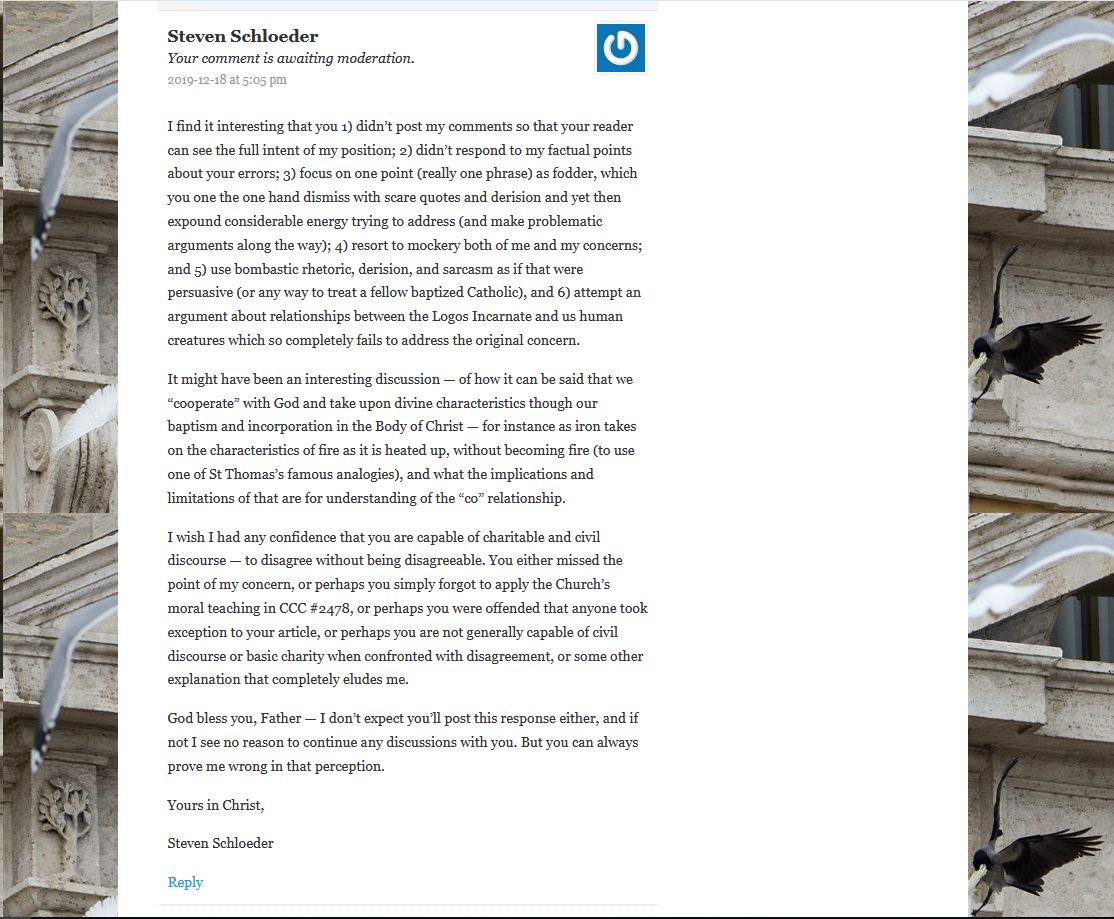
I have provided a screen shot of my reply to him, since I have no reason to think that he would approve this one either. 


Monday, December 16, 2019

Pope Francis and the title of Our Lady as "Co-redemptrix"


I am posting my reply to Fr. George Byers, who on his blog Let Us Arise treats Holy Father Francis poorly and unjustly.

The title of his essay is "Pope Francis rejects seven popes on Co-redemptrix", which is a startling statement, and opens with:
"I’m going to offer a critique of Pope Francis’ impassioned rejection of Mary as Co-Redemptrix at Mass in Saint Peter’s Basilica for the Feast of Our Lady of Guadalupe the other day, December 12, 2019"
He has several grievances, but the heart of his concern seems to be when the Pope said (by Fr. Byer's transcription and translation)
  • “Quando vengan con historias de que de declarala esto a ser trato como un dogma o esto – non la perdamos in tonteras.”
  • “When they come with stories of having to declare this [Mary as Co-Redemptrix] to be a dogma or whatever – let’s not lose her in stupidities.”
and concludes from that:

“Stupidities.” This, of course, is not a named, but is nonetheless a direct attack on seven previous popes, as well as, it seems to me – and this is perhaps to the point – on Mark Miravale, who has made this title of Co-Redemptrix a life project. He’s done a lot of excellent work on this. What Pope Francis does is simply offensive. If he wants to pick a fight, he should name his adversaries who are alive today instead of hiding behind a bully pulpit. All stupidities about Mary? Really?"
This is all seems fundamentally incorrect: the Holy Father did not reject seven of his predecessors in their use of the term "Co-redemptrix" and he certainly did not directly (or indirectly) attack them, and he did not call the term itself, nor its use "stupid", nor is even the term "stupidities" necessarily the best translation in this context.

I look to any Argentinian Spanish speakers to help here, realizing that Spanish words take on many regional nuances and even completely different meanings from Spain through the various Spanish speaking countries in North, Central, and South America.

From my own high school Spanish course, our first memorized dialogue ("¿Hola, Luisa, que tal?") is still ingrained in my synaptic neural network: a boy invites a girl to his birthday party, she coyly suggests he is only inviting her so he will get more birthday presents.  He replies,
¡No seas tonta! ¡No te invito por eso!
Don't be silly! I don't invite you for that!

I cannot of course speak dispostively here -- my Spanish is not that good, and I am try to construct from context what the Holy Father seems to have been suggesting: after all, immediately after admonishing people to not demand that the Church must declare Our Lady as Co-Redemptrix as a new dogma, he continues to remind us all of what can be unambiguously said of her, on the great occasion of the Feast of Our Lady of Guadalupe:

María es mujer, es Nuestra Señora, María es Madre de su Hijo y de la Santa Madre Iglesia jerárquica y María es mestiza, mujer de nuestros pueblos, pero que mestizó a Dios.
which seems to be something like:
Mary is the Woman, is Our Lady, Mary is the Mother of her Son and of the hierarchical Holy Mother Church, and Mary is mestiza (a 'mixed race woman'): a woman of our people, but who "mixed" with God.

I cannot bring myself to think that the Holy Father chose the Feast of Our Lady of Guadalupe to insult the Virgin. This is the Vatican link to the official text of his homily in Spanish.

Here is the (slightly corrected) comment I made on Father Byer's blog:
I'm pretty sure tontaras (tontaria) in this case is more like "silliness" -- no nos perdamos en tonteras seems more to say, "let not lose ourselves in silliness".   And what is being said to be silly?   That we must declare Mary as Co-Redemptrix as a matter of dogma.  

Pope Francis did not call that title "stupid".  He did not say any of his predecessors were stupid. He did not reject seven of his predecessors. 

BTW, you seem to be the only one who transcribes what he said as "non la perdamos in tonteras"    Most give "No nos perdamos..." which is what it sounds like to me, though I'm not fluent in Spanish and the Argentinian accent is not something I'm familiar with. I would advise you to check on this -- "no nos perdamos en tonteras" makes sense as I have translated it -- your "Don't lose her" is not so clear since he is speaking about the claim that she must be declared Coredemptrix as a matter of necessary dogma.

Cardinal Ratzinger was also concerned for the use of the term as well. His concern seems more than just "it’s correct but the wording could be misinterpreted", but rather that the term itself "departs to too great an extent from the language of Scripture and of the Fathers, and therefore gives rise to misunderstandings."  and

"“Everything comes from Him [Christ], as the Letter to the Ephesians and the Letter to the Colossians, in particular, tell us; Mary, too, is everything she is through Him ...  The word ‘co-redemptrix’ would obscure this origin. A correct intention being expressed in the wrong way."  (Cardinal Ratzinger with Peter Seewald, God and the World: A Conversation). [quote taken from David Armstrong's blog on this topic].

"Co-" seems to be too strong of a relational signifier:  co-pilot, co-conspirator, cooperator, co-chair, coworker, coadjutor, etc -- this prefix implies an equality in acting; that either can do the act, and it not a term of necessary subordination.  So I think there are valid reasons the term has not been officially adopted, let alone defined. 

Above all, theological language are terms need to be precise -- the avoidance of ambiguity is important for Christology, as for Mariology.  Other popes may have used Co-Redemptrix as a title without ever defining exactly what was intended: to do so from a papal office would be to make it magisterial as a formal and official definition -- akin to a dogmatic or doctrinal definition.  I can understand why no previous Pontiff did so: it is not necessary for the Faith, and might well be imprudent to do so.  Holy Father Francis seems to say the same, though in his characteristically rougher manner.

I ask you, Father George David Byers, to retract this essay -- it is an unjust and problematic account of what the Pope actually said, and comes across as an attack on the Supreme Pontiff.
Yours in Christ,

Steven J Schloeder, PhD (Theology)
Swarthmore PA

Friday, August 16, 2019

The Government in Ottawa gives permission to build a wall

To protect the citizens from beauty. 

Above: The existing Château Laurier seen from Major's Hill Park. Below: The proposed and approved design by architectsAlliance.


One sees an obvious typology to the various border wall projects proposed for America's southern border.


Border Wall Prototypes (from cms.qz.com)

This raises the obvious question of why the architects chose a barrier wall type as their civic expression?  What are they enclosing or defending or protecting or excluding or demarcating? Is this some slavish obedience to the zeitgeist

Contrast this to the design sensibilities of the original architects and developers a mere century ago: 


The existing Château Laurier in Ottawa, designed in a stately early 20th century French Chateau Revival style, was intentionally designed to complement the neighboring Parliament Buildings on Parliament Hill, a promontory overlooking the city.


Image from Google Earth: The Chateau Laurier in the foreground with the Parliament buildings behind

The developer of the original hotel, Charles Melville Hays of the Grand Trunk Railway, had commissioned the original architect, Bradford Lee Gilbert of New York, to harmonize with the civic scale and architectural referents of the adjacent governmental complex.


Château Chenonceau, Loire Valley, France (image from Wiki Commons, GNU free)

The original Château Laurier was a poor man's Chenonceau, a traveler's hotel where private rooms could be had for $2 a night, or a traveling salesman could sleep dormitory style with common baths. But the architecture on the personal and civic scale spoke of a dignity to which we all aspire and which was once expressive of a view of the person in relationship with history, tradition, society, and beauty.

While Gilbert was removed from the project, and was succeeded by Ross and Macfarlane  of Montreal, the intentions and the talents of the architects and developer were clear. Even in an age of architectural pluralism and historical stylism, when one could design convincing civic and institutional buildings in Greco-Roman Classicism, Neo-Gothic of either the French or English Tudor variants, Italianate, Mission Revival, Egyptian, or Renaissance Palladianism, the civic sensibility was to design with respect to and regard for the neighbors.

The limits of Modern Architecture


This was an age before the hegemony and totalitarianism of the Modern movement which  effectively mandated that all buildings should be built in modern materials (steel, concrete, plate glass), without regard for context or civic engagement, and certainly without reference to the human person or the architectural patrimony of the past. So for the past 100 years we have been building buildings indistinguishable from any other typological building built anywhere else or at any time since.

The modern architect is today limited to the programmatic and functionally driven dictates of the project, massing to maximize the code permitted envelope, and to articulate the box with a limited vocabulary of materials, with window shapes and building massing which don't need to correspond to the internal organization of the building.

The architecture of modernism is reducible to the functional and economical, manipulated by the idiosyncratic mind of the architect as form giver. It is no longer a truly public art which respects the civitas. A planning consultant for the design team, one Dennis Jacobs, is on record as stating in defense of the design and in rejection of the public outcry against the design:
This is not a court of public opinion — this is a municipal government decision.
And the gatekeepers of the civitas -- in this case the Ottawa Council -- have been as negligent in oversight as Epstein's jailers.

Polite Buildings for the Polis 


Architecture is the most durable of the arts, and the most informative and impactful of how we organize our lives in the public realm and shape our common life. This is precisely why architecture has an ethical aspect to it: architects, developers, municipal planning staff and elected officials have obligations to the community far beyond the mere financial benefits of the industry. One is permitted to pursue one's private goods -- in this case the financial gain from being a hotelier or a developer or an architectural firm -- but not at the expense of the common good.

And in this case, we can consider the common aesthetic experience of the entire community to be a part of the common good: those things which we share in common without competition or exclusion (the principles of non-rivalry and non-excludability). This principle of the common good is all the more important as the scale and prominence of the "good" is considered:  no one really ought care what your garden shed looks like, whereas we all have a vested interested in how our civic scaled architecture and public spaces affect us. And the fact that architecture has not only an aspect of non-excludability, but forced and coerced inclusion, heightens the ethical demand on the owner, the design team, and those entrusted with the common weal of the community.

With this in mind, we can better appreciate the efforts of those who over the past several decades have renewed an interest in the communal aspects of architecture and urban planning, notably groups such as INTBAU, the Congress for New Urbanism, the Form-Based Codes Institute, numerous professionals in private practice, and select programs at some schools of architecture such as the School of Architecture at University of Notre Dame. 


I mention the last one in particular given that one of the graduate students, Michael Pfaff, has drawn up an alternate proposal to solve the same design problem given to the architects of record.


Such an approach respects its neighbors.  It does not think to pile up overseas shipping cargo containers (as Ottawa Mayor Jim Watson likened the approved design) next to your lovely home simply because that's what the architect fancied. It is a truly civic and civilized architectural approach for the civitas, a polite architecture for the polis, and rejects the radical, isolated individualism of Ayn Rand's Howard Roark which is the manifested expression of the Enlightenment rejection of tradition, relationship, and natural community.

It is certainly interesting that only 20 years ago, the previous owner of the hotel, the Fairmont Group, received planning permission for a similar expansion to the Château Laurier, which was respectful of the original design intent. This was very much the same approach when in 1929, the hotel added a whole 240-room wing keeping with the existing Val de Loire Château style.


The 2000 proposed addition to Château Laurier, by Le Group Arcop. Thanks to Scott Moffatt, on Twitter, for this reference.

It is noteworthy that past ages once saw the virtue in treating people in the fullness of their dignity.  In service of persons made in imagines Dei, truly noble beings worth of beauty and a civilized life,  the architecture supported and manifested a vision of civic virtue. The aristocratic style of the Loire Châteaux seemed to be a fitting architectural expression. Once the style of the grand nobility, the democratization of the new world saw these historic styles as apt for the dignity of the citizen in the new modern nations. 

What will be built speaks rather of the individual as an economic unit, to be warehoused in a container, embedded in a great wall.  And rather than providing a grand facade which extends the presence of the historic Château Laurier, the approved project will literally deface the hotel from the Ottawa skyline. It will hide the humanizing and historic architecture behind a steel wall more fit for border control.


Monday, October 24, 2016

Thoughts on The Walking Dead (NO SPOILERS)

Season Seven opener was brutal -- some say "violence porn" -- others have said "enough!" and stopped watching it.

I was out in Arizona, without access to cable to watch AMC, and my wife didn't want to wait for my return...  So in this curious age of innovation, we up her iPad to film the TV screen while I watching it streaming live on my iPhone.  Necessity is, indeed, the mother of invention.


A few thoughts occur to me about this program:

1) I understand and respect if you stop watching the show because of the graphic violence. It's certainly not a "Christian" show imbued with all sorts of plain virtues you want to pass on to your children. It's more like Flannery O'Connor -- what is life without grace; or showing by absence how we are allowed to acquire virtues and civil organization and culture because of the stability of society and governance, and how we would be forced to live in a state of raw nature if that were suddenly stripped away.

2) The brutality of the violence, and our reaction to it, is due to the sense of "relationship" we have with the characters. We are not so moved when "others" meet their violent ends, even at the hands of our favorite characters. Yet these too have backstories and trajectories and narratives, and a story could be told about any of them, and then we would care about them and their deaths.

3)  The opening season episode complete changed the psychological dynamic of all the main characters, esp the protagonist -- how is that not really relevant character and story line development?

4) The backstory on Negan should be really interesting as well -- how does a man become that person, or was he always so, and how does he justify his acts for the sake of the community? He's a microcosmic US government, or any sovereign, who will crush anyone to keep order by keeping everyone in line for the good of the whole. This is all jarring to us because we as so softened to our democratic sensibilities, but he's basically a Carolingian warlord or a Tudor king, absent the Church to direct and constrain his morality.

No, it's not "Christian" show, but you can't get away from the perennial issues of life, meaning, social order, moral reasoning, or the fallen human condition that the Church and the Gospel so brilliantly answer toward.  As one friend, a completely grounded, intelligent, and orthodox Catholic priest, noted, "I think TWD is the most subversive show on TV that even attracts those it's subverting--urban and suburban soft Lefties who think tax dollars, teddy bears, and niceness seminars will save the world."

Your thoughts?

Sunday, March 13, 2016

Building the City of God Here on Earth....

I'll be speaking at the International Institute for Culture this Saturday night on the intersection between Catholic social teaching, church architecture, and urban planning. 


If you're in the Philly area, stop by for the talk and meet a wonderful group of people!

more information here: International Institute for Culture

http://iiculture.org/details.asp?idOfEvent=530

Monday, May 11, 2015

Our Lady of Grace - Progress Update


We are thrilled that Our Lady of Grace Catholic Church, in Maricopa, Arizona,is now under construction! The Blessing of the Site and the Ground breaking ceremony was on March 1st, 2015, and since then Redden Construction has been working steadily and efficiently to build the church.

Phases 1A and 1B (last year) was to install the site infrastructure -- roads, utilities and sewer, grading and drainage, etc) -- and the parking lot for the church.

Phase 1C is now under construction for the 500 seat church, with the administration building to follow next year as funds are raised.

Michael Barnes, a long time parishioner and member of the parish Building Committee, has been filming the progress of the construction with his quadcopter and Go-Pro camera. Enjoy the video see the wonderful progress being made!


Thursday, September 4, 2014

No third way: Catholicism vs gnosticism or nihilism

Christ giving the Keys to St Peter: Pietro Perugino (1481-1482) Sistine Chapel
A comment I read got me thinking:

> but I'm afraid I can't conclude God's voice is that of the Magisterium at least on some issues.

That's an epistemological problem between Catholicism and gnosticism/ nihilism.
It's pretty binary: Either A) Christ founded the Church as a sure and objective means of knowing the Gospel, and endowed the Church with the gifts to safeguard the teaching in matters of faith and moral so that we can be certain of how we must act and what we must hold and believe in order to conform our lives to God's plan and purposes for human relations; or B) there is no sure way of knowing anything about faith or morals, only objective material facts.

If B, then all interpretation is just a subjective gnosticism -- my own experiential knowledge (gnosis) is all that counts and by that I judge the Church as deficient.

I don't see a third way here -- either the Church is what she claims to be, along with her mission, sacraments, teachings in matters of faith and morals, and essential structure -- or everything is up for grabs. At that point the Church is nothing more than a social club of like minded people who like the Church for whatever comforts one subjectively finds in that association. There can be no mechanism where we can know that any one point of doctrine or any one act of the Church or any one moral teaching has anything to do with God's plan and purpose, with his will for our lives together or as individuals. So all valuation is likewise subjectively determined (not even "culturally constructed") and there is no reason to objectively value one thing over another.

It's basically why I am Catholic rather than a nihilist or a gnostic. Picking and choosing what parts of the Magisterium to attend to is not the practice of the Catholic faith but one's own personal and private religion where the Church is only true as long as it reflects what you demand of it.

Sunday, August 24, 2014

It may not look like much just yet....

It may not look like much just yet, but the ground work is now underway for the new Catholic church in Maricopa, Arizona.  

Aerial view of The Crossing from the south west.  The new church will sit just left of the newly paved parking lot.
More than just a parish church, the project will be not only the spiritual center for the city's 10,000 Catholics, but will create a whole new city center in the rapidly growing city of Maricopa.

When complete, The Crossing will serve the parish and the greater community of Maricopa with a church, school, housing, businesses, and recreational areas.

Sitting on 38 acres of land, The Crossing is a new planned area development that will create a sustainable and walkable neighborhood with church and school, residences, shopping, offices, and business opportunities.

A broad range of residential, church and civic, educational, retail and office uses will create a truly pedestrian friendly and community oriented neighborhood in the heart of Maricopa Arizona.

The centerpiece of the Crossing will be the new 500 seat Catholic church for Our Lady of Grace Parish.

Phase 1 of the new church will accommodate 500, with a new parish administration and social hall.

Eventually the site will be home to several hundred residences in single family, apartments, condominiums, and elderly housing.

Character study of apartment houses. By creating a larger scale multifamily residence, the building itself helps to define character of the street, making the buildings more noble and the street more interesting for pedestrians.
In addition, commercial retail and office, restaurants and various social and civic services are planned.

Character study of street scape, showing live-work units with street-level retail, and multi-family apartment houses

The entire site has been designed to serve the families and the community with significant public amenity spaces such as a church plaza, a town square, village greens, sports fields, and a central park.

Significant public areas for social activities are planned throughout the property.

The project incorporates the best practices of form based codes, smart growth, and new urbanism. This includes the use of "build-to zones" instead of "setbacks"; ancillary dwellings that provide single family residences to have on site rental opportunities; shared parking arrangements and on street parking that significantly reduces the required amount of parking (reducing costs, environmental impact, and heat gain, and providing for more social and community oriented land use).

By creating a "build to zone" instead of a building setback, the stores are pushed up to the street frontage, which creates a pedestrian friendly area and helps to define the sense of place.
There is also a variety of traditional building types such as row houses, bungalows for starter houses, low income, and downsized families, and live-work units.

Rowhouses define the common "village green" which becomes a place for community, recreation, and play.

Character study of bungalow houses grouped around a "village green".  These smaller houses serve lower income, starter houses, and down-scaling retirees. By socializing the public areas, more land is given over to the whole community while providing economical private residences.

The project broke ground in April 2014, and the first phase of the grading, drainage, roads and infrastructure are now being installed by Chasse Building Team.  The parish is looking to complete its fundraising and financing campaign to receive permission from the Diocese to start construction of the new church as soon as possible. 

The new church will have a strong street presence announcing itself to the whole community, and will define the church plaza as a place for the whole community to enjoy.
It may not look like much now, but take a peek at the video of the site development, videoed by Mike Barnes with his quadcopter and Go-Pro camera.  The church will be soon rising on the large open field between the roads and the paved parking lot seen in the video.


For more information, contact the parish at:

Our Lady of Grace Catholic Church
45295 West Honeycutt Avenue
Maricopa AZ 85139

t. 520.568.4605

or leave a message here in the comments.

Monday, July 21, 2014

For our friend Stratford Caldecott, a man of soft voice, great books, belles lettres, and fierce intellect.

Man rises to fall: he tends to dissolution from the moment he begins to be; he lives on, indeed, in his children, he lives on in his name, he lives not on in his own person. He is, as regards the manifestations of his nature here below, as a bubble that breaks, and as water poured out upon the earth. He was young, he is old, he is never young again. This is the lament over him, poured forth in verse and in prose, by Christians and by heathen. The greatest work of God's hands under the sun, he, in all the manifestations of his complex being, is born only to die.
 
His bodily frame first begins to feel the power of this constraining law, though it is the last to succumb to it. We look at the bloom of youth with interest, yet with pity; and the more graceful and sweet it is, with pity so much the more; for, whatever be its excellence and its glory, soon it begins to be deformed and dishonoured by the very force of its living on. It grows into exhaustion and collapse, till at length it crumbles into that dust out of which it was originally taken.
I met Stratford about 25 years ago, when he encouraged me to pursue my work in church architecture. I had recently finished my master's work at Bath, and was living in London working as an architect. We met through the encouragement of our mutual friends, Richard and Carol Downer and John Saward, and had occasional lunches in the city talking about the faith, Newman and the Second Spring, Chesterton, art and architecture.

Strat took great interest in my recently completed thesis which critiqued modern Catholic architecture and sought to propose a new direction for the recovery of the deep, sacramental traditions of church design. Stratford understood what I was trying to say, he advocated for me without reserve, and he helped me find my voice.  He tried (unsuccessfully) to get the book ‘Architecture in Communion’ published through Harper Collins, but when I returned to the States we kept in touch and he asked me to write an essay for his journal Second Spring, which was then published through Catholic World Report.

From that article, priests started asking me to design churches, Ignatius Press determined to pick up the book, I was then invited to pursue the doctorate at the Graduate Theological Union, specializing in liturgy and architecture, and I now work primarily in Catholic church architecture. Looking back over the decades, I can see how Strat was instrumental in God's providence for my life as my career finally became my vocation.

We kept in touch over the years, and Strat asked me continue writing, encouraging me to write booklets on church architecture for Catholic Truth Society. Through fits and starts, missed deadlines, and grappling with how to take such a broad topic down to the level of a booklet, he regularly cajoled me to keep on task. For that is what Strat himself did: in 2011 he was diagnosed with prostate cancer. Throughout his sickness and treatment he continued to soldier on, doing what he was called to do, neither losing heart nor changing course because of the illness. He kept advocating me to his publisher, kept encouraging me to finish the manuscripts, and he shepherded them to completion. The first, Catholic Architecture, was published in May 2013 and the second, Understanding a Church, was published in May this year.


I dedicate both of those books to you, dear friend.

By May 2014, it was clear that his prognosis was fatal, and he told me that the doctors anticipated he would not make it through the summer. At the time I wrote to him, grateful that I could let him know in part the impact he had on my life:

‘You have been such a blessing to me — and I can honestly say that I am now working full time serving the Church in architecture mostly because you have advocated me and my ideas. That is a strange and wondrous bit of providence — probably not too significant in the grand scheme of things, and you have done so very much for so many in to help light their path in service to Christ — but for me it has been determinative. You have very much been part of the way our Lord has shaped the trajectory of my life. I simply want you to know that, and to let you know how grateful I am to you for your friendship and support.’
Stratford died this past week, leaving behind his loving wife Leonie with his beloved daughters and a profound legacy of friendships, writings, and scholarly initiatives. He was a reader of the great books and a writer of belles-lettres, he spoke quietly, in soft tones, always measured in his thought and words. Yet that gentle manner hid a fierce intellect and a leonine spirit (how apt that his beloved life's companion was so named), intent on serving the Lord and his Church.

The funeral mass will be held at the Oxford Oratory on July 31, at 10 a.m., and he will be laid to rest in the Wolvercote Cemetery, near the grave of J.R.R. Tolkien.

Please lift an Ave for the repose of the soul of our dear friend, and for the consolation of his family.


Thursday, June 12, 2014

Priests attacked in Phoenix

Please pray for the repose of the soul of the priest killed tonight in a shooting at Mater Misericordiae Mission in the Diocese of Phoenix.  Another priest was seriously wounded, and is in the hospital.  The victims are still unnamed; the parish is staffed by Frs. Joseph Terra, FSSP,  and Kenneth Walker, FSSP.

BREAKING NEWS

The parish is being served by priests of the Priestly Fraternity of St. Peter (FSSP), a society of apostolic life dedicated to the new evangelization, the formation of clergy, and the restoration of the Church's liturgical life through the promotion of the Extraordinary Form of the Mass (the "Latin" Mass).  The FSSP and her priests have been wonderful examples of holiness, devotion, and prayer in the Diocese of Phoenix, and have worked diligently with Bishop Olmsted in the recovery of the liturgy and the promotion of beauty in sacred art and architecture in the service of the liturgy.


Please remember the deceased in your prayers, as well as the wounded and those who committed these crimes.

UPDATE:

The victim has been identified as Fr. Kenneth Walker FSSP, age 28, who was mortally wounded in the attack. Please pray for the repose of his soul and the consolation of his family.

The late Fr. Kenneth Walker FSSP blessing Bishop Fabian Bruskewitz

Fr. Joseph Terra FSSP was serious injured and has been hospitalized.
Fr. Joseph Terra FSSP

In paradisum deducant te Angeli; 
in tuo adventu suscipiant te martyres, 
et perducant te in civitatem sanctam Ierusalem. 
Chorus angelorum te suscipiat, 
et cum Lazaro quondam paupere 
æternam habeas requiem.

Wednesday, April 23, 2014

Understanding the Theology of the Baptistery

The baptismal font at Sts. Anne and Joachim Catholic Church, Fargo, ND.  Building design and liturgical furnishings by Liturgical Environs PC.  Architect of Record: Zerr-Berg Architects, Fargo ND.

When we enter a Church, we reach for the holy water stoup to bless ourselves: a symbolic renewal of our baptismal vows in a small and compressed way. This act is part of our entering into Mass, which itself is a compression of the yearly liturgical cycle, which finds its fullest expression in the liturgy of the Paschal Triduum at which adult catechumens are normally baptized. But the yearly cycle, and the Triduum, are themselves compressed expressions of all of salvation history, which begins when “God created heaven and earth, the earth was still an empty waste, darkness hung over the deep, but the Spirit of God hovered over the waters” (Gn 1:1-2) and end with the manifestation of, “the new Jerusalem being sent down by God from heaven, all clothed in readiness, like a bride who has adorned herself to meet her husband” (Rev 21:2). As we shall see, the baptistery, the font, and the rite of baptism are called upon to express and manifest a huge and interwoven body of scriptural, liturgical, and sacramental thought, which frankly is a massively difficult task today.

"In the Genesis account of creation and the Garden, there were no doors or portals or gates or walls. The gates of paradise could only be said to be closed after the expulsion; before that all of creation was the domain of man as part of the “garden of delight” into which God placed Adam and Eve."

We might start by understanding that the holy water stoup receives its symbolic imagery from the baptismal font, but the font receives its imagery from creation itself. In the Genesis account of creation and the Garden, there were no doors or portals or gates or walls. The gates of paradise could only be said to be closed after the expulsion; before that all of creation was the domain of man as part of the “garden of delight” into which God placed Adam and Eve. Doors, gates, portals, and such (along with all the symbolism of dwelling apart from nature: the cave, the tent, the house, the temple) are consequences of alienation from God. It is thus fitting that by Jesus’ example, the order of creation is restored through the waters of baptism where we are no longer alienated from God or each other, but rather enter into a new and restored relationship in Christ through this first sacrament. This alienation will only finally and completely be eradicated in the heavenly Jerusalem. Significantly, the gates of the heavenly Jerusalem will never be shut (Rev 21:25). Unlike the ancient Roman portal, or city gate, that was unconsecrated so that unclean things could be carried across the threshold, the gate is Christ himself who calls all nations to himself (Rev 21:26). Nothing unclean or corrupt or mendacious will ever pass the gates for “there is no entrance but for those whose names are written in the Lamb’s book of life” (Rev 21:27). This passage shows the restoration, even the reversal, of the Fall: now the garden is restored with the life giving waters that flow from the throne of the Lamb (Rev 22:1), the waters nourishing the tree of life that bears fruit all twelve months of the year, the fruit of which brings health to all the nations (Rev 22:2). Recalling the passage in Ezekiel 47, the water flows from the right side of the temple eastward, that is from the side of the crucified body of the Lord. The throne of the Lamb in Revelation 22 can thus be understood to be the cross, for when one of the soldiers pierced the side of the Lord, blood and water flowed out (Jn 19:34).

The baptismal font at Our Savior Catholic Church, University of Southern California, Los Angeles CA.The raised infant font trickles into the lower immersion font for adults.   Liturgical design by Steven J Schloeder AIA, Liturgical Environs PC.  Design Architect: Elkus Manfredi, Boston MA. Architect of Record: Perkowitz + Ruth, Los Angeles CA.


Thus, baptism not only commences our journey in Christ, it also both causes us to participate in his passion, death, and resurrection, and is a foretaste and promise of our destination in Christ. The intended message of baptism is primal—primal both as “of first importance” and as “originary” both to creation and to our lives as Christians—and this importance was expressed in the early Church by a clear separation between the font and the altar, between the unbaptized catechumens and those who were admitted to the “mysteries” through the disciplina arcani. As St. Justin Martyr tells us of the primitive Christian practice, the catechumens are first brought to a place where there is water to be baptized, and after the new Christian has been washed, is then brought to the places of the Eucharistic assembly. 1 Not until the neophyte (literally, “new growth” as part of the vine and branches imagery) was received into the Church, and taught the fuller mysteries of the Faith, would he or she be admitted to the Eucharist.

it makes no difference whether a man be washed in a sea or a pool, a stream or a fount, a lake or a trough; nor is there any distinction between those whom John baptized in the Jordan and those whom Peter baptized in the Tiber…” (Tertullian). Shown is The Baptism of Priscilla, by John H DeRosen, c. 1951-1953.  St John's Episcopal Church, Memphis TN.

The place of baptism in the primitive Church could be any place with water: a public bath, a town well, a spring or river or lake or sea. Christ was baptized in the River Jordan; St. Phillip baptized the Ethiopian official at some non-descript place of water (quamdam aquam); St. Paul found some water to baptize his jailer, and the man’s household. Tertullian, writing in the second century, comments: “it makes no difference whether a man be washed in a sea or a pool, a stream or a fount, a lake or a trough; nor is there any distinction between those whom John baptized in the Jordan and those whom Peter baptized in the Tiber…2 The context of this passage gives us insight into the Church’s understanding of the sacraments themselves.

For the North-African theologian, Tertullian, as for the ancients in virtually every culture, water itself was a sacred and life-giving thing, but also a dangerous and deadly thing. Tertullian points out that water is used by all cults as means of purification—the followers of Isis and Mithras, the Zoroastrian, Apollinarian and Eleusinian rituals, the Egyptians, Jews, and Romans, all used water for purification and illumination. Justin Martyr had earlier commented that the healing properties of water were perverted by the demons, such that the false religions also had rituals of washing and sprinkling before entering the temples for their idolatrous practices. 3 Water was, therefore, universally understood to nourish and sustain life, but also was associated with both death by drowning, as well as various maladies of madness such as “nympholepsy”, “hydrophobia,” and “lymphatic” illness. Sacred springs were places of healing, such as the Pool of Siloam (Jn 9:7ff), or at Bethsaida that was stirred by the angel for healing (Jn 5:2-4), as well as for the pagans at Sulis Minerva, which is now the City of Bath. Conversely, swamps and putrid waters were places of contagion and evil, inhabited by evil spirits. Because of the primal and cosmological nature of water—that “the Spirit of God hovered over the waters”—water itself is “in a manner endued with medicinal virtues.” The Spirit of God continues to hover over all water, which is the cause of its holiness, and becomes the apt sacramental symbol for new life, cleansing, and sanctifying: “Thus the nature of the waters, sanctified by the Holy One, itself conceived, therefore, the power of sanctifying.” 4

Tertullian thus considered water as the apt symbol of baptism—not merely by some general sign-value that we are washed in water, or that we are born and nourished in water, or that it can express death in Christ—but because the Spirit of God continues to linger over the waters and, so by divine fiat, water is itself a source of sanctification. It is a proper sacramental sign since by revelation we know it is an outward sign of an inward grace in the operation of the Holy Spirit, much as by the words of institution by Christ, the bread and wine used as Mass are, indeed, the Body and Blood.

continue reading on Homiletics and Pastoral Review

Friday, April 11, 2014

The Gospel of Jesus' Wife


The recent discovery of the ancient Coptic manuscript purporting to Jesus speaking of his wife has rocked the world of both archeology and gynotheology. A team of scientists has concluded that the fragment, a mere 1 1/2" x 3 3/4" containing 33 words, is not a modern forgery.

Radiocarbon tests conducted at Harvard and the Massachusetts Institute of Technology produced an origination date for the papyrus of 659-859 CE, according to Harvard. MIT also studied the chemical composition of the papyrus and patterns of oxidation.

Dr. Karen King, a Harvard Divinity School historian,  first announced the existence of the fragment in September 2012, at the International Coptic Congress in Rome, where she dubbed it "The Gospel of Jesus's Wife." Prof. King cautioned, that this miniscule fragment does not prove conclusively that Jesus was married.  Mr. Myron Leibermann, a junior account executive at Publicistas who are actively pursuing the branding rights for this product, concurred: "Sure we know that this little scrap proves nothing, but we think "The Gospel of Jesus' Wife" is a pretty sexy title for it --- you're only as good as the publicity you can generate. That's what makes coin!"

According to Dr. King, "This gospel fragment provides a reason to reconsider what we thought we knew by asking what the role claims of Jesus's marital status played historically in early Christian controversies over marriage, celibacy, and family," King said.  She did not elaborate on how a fragmentary scrape from over six hundred years after Jesus lived, and well into the late Byzantine age when Christianity was already doctrinally solidified by the Great Ecumenical Councils, could given any reason for calling into question what the Church had long established.

"This papyrus apparently dates circa the Second Council of Nicaea (787 AD), at which point the Church was speaking to more mundane matters like whether Jesus could be depicted on icons, in response to the Iconoclastic Controversy under Emperor Leo III.  There is no evidence that any such debates were occurring among the orthodox catholic churches at the time this fragment dates, nor any time previously, except for bizarre gnostic sects like the Montanists and the author of the spurious Gospel of Philip", said Billy Chandler, a local area high school senior at Our Lady of Critical Thinking Catholic High School, who displayed a better grasp of early Christianity than the Harvard professor. 

Inexplicably, Dr, King opined: "The main topic of the fragment is to affirm that women who are mothers and wives can be disciples of Jesus—a topic that was hotly debated in early Christianity as celibate virginity increasingly became highly valued."

Other scholars point to the many examples of women who followed Jesus, were mothers and wives, served in the Church in caring for widows and orphans, opened their houses for early Christian worship and community, assisted to baptize women at the time when baptisms were in the nude, and even underwent torture and martyrdom for the sake of the Gospel. "Hotly debated?  pfffft.... Hasn't she read the acts of Perpetua and Felicity? Perpetua was a married noblewoman with a suckling baby, and Felicity was pregnant at the time... which raises some questions about the conditions of their respective hymens", stated Dr. Jean Bolland, who holds the Delehaye Chair in Hagiography.

A careful study of the 7th to 9th century Coptic papyrus, read in the context of other ancient papyri troves such as  from Nag Hammadi and Oyxrhynchus, give a decidedly different possible explanation of the Gospel of Jesus' Wife.

Dr. Benjamin Bell, a world renown papyrologist specializing in ancient Jewish humor in the middle Nile region, suggested that, "This is a wonderful rare find, a real treasure for us all.  Little is known about Jewish life in Egypt during the late Classical period apart from a few papryi. The persecutions under the goyim left the Jewish communities impoverished and tight-knit, but at least they retained their sense of humor. Based on the hand writing style this fragment appears to have come from the hills outside of Koptos where there was a thriving Jewish community in the late Byzantine age that specialized in self deprecating jokes".

Dr. Benjamin Bell, world renowned Egyptologist and specialist in ancient Jewish humor

Prof. Bell compared this to other ancient manuscripts, and suggested that this was a script from a precursor to the later Borscht Belt comedians. "The missing parts are contextually reclaimable:  "Jesus said to them, ' [take] my wife, [please]  ... [gevalt!] She will also be my disciple [? I was just looking for a date and a little hanky panky!]" 

Another interesting passage seems to be an early form of the old Semitic joke, "Let the wicked people swell up... [like the armpits infested by the fleas of a thousand camels]".   Dr. Bell suggested that the partial "my moth.." probably refers to another regional schtick, "[Just got back from a pleasure trip: I took] my moth[er-in-law to Cairo]".

Prof. Bell also pointed out  that other parts of the fragment appear to include the partial phrase: "I'll be [here all week, try the veal]" and "D[on't forget to tip your waite]r."  He indicated that a lot of Byzantine-era standup comics often stole material from each other, as evinced by the 5th century text from Schlomo the Pseudo-Goniff.  "But its all comedy gold," asserted Dr. Bell, "GOLD!".

Thursday, March 13, 2014

The Christ Child Shrine: A Call for Artists

We've been working on wonderful project to design a shrine dedicated to the Christ Child at the Mount Claret Retreat Center. The shrine itself will be an outdoor, open air shrine, intended to create an enclosed garden space for contemplation as part of a much larger campus plan.


The shrine sits in a larger garden area as a separate place for prayer,  meditation, and quiet conversation for the retreat guests.
The heavy rubble masonry continues the same texture and mass found through out the existing site, and is respectful of the indigenous desert architecture of the ancient first people in the American Southwest. The rich blue interior is intended to create a cool and refreshing interior, in a subtle way alluding to the cloak of Our Lady in which we find consolation and intimacy with her Son. 
 The Shrine is also intended to be a sort of oasis in the desert, a place of refuge from the sun, with a canopy of trees and the element of water to create a microclimate despite the heat of the day.


The themes of the Christ Child shrine are related to life and the fundamental religious intuition: the oval shape recalling the womb and the egg, water and fire, the Tree of Life, the stone forms arising from the earth,as well as the encompassing womb like shrines of the earliest known sacred architecture such as at Göbekli Tepe and the hypogea at Malta.


Shrine is the first phase of a larger landscape and master planning project for Mount Claret, which will eventually include a desert garden for the Stations of the Cross as well.


The focal point of the shrine will be a sculptural image of the Christ Child, probably a bronze or stone carving, three dimensional, depicting Jesus in some appropriate posture and gesture, with the age and artistic details to be determined, but probably more of a pre-adolescent or adolescent rather than an infant or toddler.


The artistic details will be worked out with the selected artist.  The figure will be approximately 4' tall, on a 6" to 8" plinth.


Interested artists are encouraged to submit a portfolio and a proposal to us at:

Steven Schloeder AIA
Liturgical Environs PC
9402 South 47th Place
Phoenix AZ 85044

t. 480.783.8787
e. steve@liturgicalenvirons.com